

This article evaluates a simple global momentum-rotation strategy against a clearly defined passive benchmark. The historical results are a backtest, not a promise of high returns. They depend on the selected universe, rebalance rule, start date, transaction-cost assumptions and availability of investable country ETFs. No untouched out-of-sample test is shown here; taxes, spreads, capacity, tracking error and parameter sensitivity may materially weaken the result.
A simpler form has been hiding in plain sight.

It keeps the core engine — the structural persistence of price trends — but removes the friction. With low-cost single-country ETFs, minimal turnover, and only few trading days per year, the Global Momentum Rotation Strategy (GMRS) delivers the same underlying edge in a form a modern investor can actually implement.
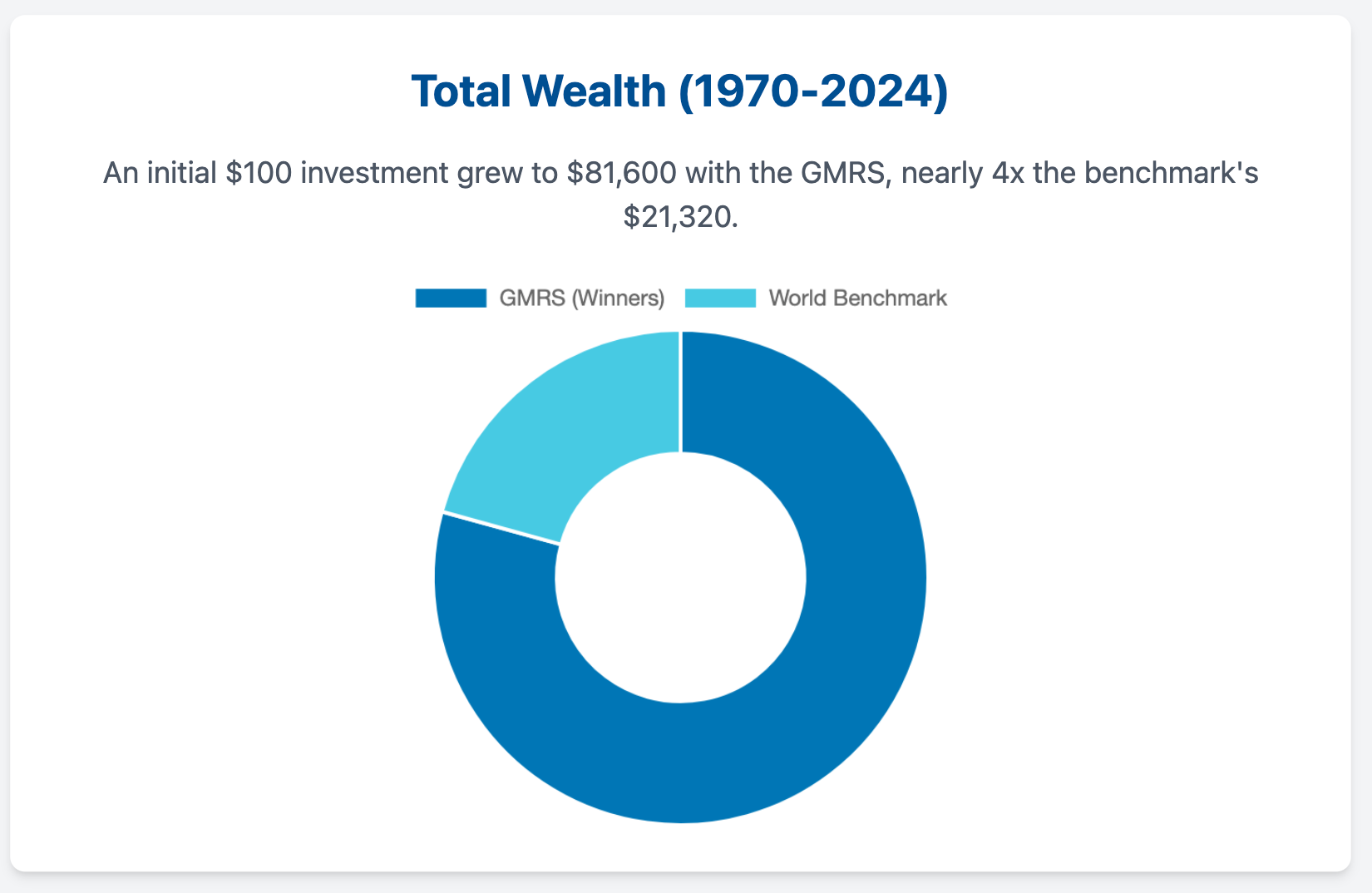
From June 1970 through December 2024, GMRS compounded at 13.09% annually, well ahead of the MSCI World’s. That 275-basis-point gap over MSCI may sound modest, but compounding makes it massive:
$100 → $81,600 using GMRS
$100 → $21,320 in the global benchmark
One small structural choice created a four-to-one wealth difference.
This is what a historical pattern in this sample looks like — quiet, repeatable, and hiding behind ordinary rules.