

Imagine an AI system discovers a trading strategy.
The formula fits on one line. The historical performance looks excellent. You can understand exactly why it buys or sells an asset.
Would you trust it with your money?
It’s becoming an increasingly relevant question. AI is making it easier to explore thousands of trading ideas, test different combinations of indicators and identify patterns that human researchers might overlook.
And unlike some complex machine-learning models, the final strategy can be surprisingly simple.
But there’s a problem that is easy to miss.
The more strategies we search through, the more likely we are to find an impressive backtest — even when none of the strategies actually predicts the market.
To explore this, I examined two recent AI research papers and ran my own controlled experiment.
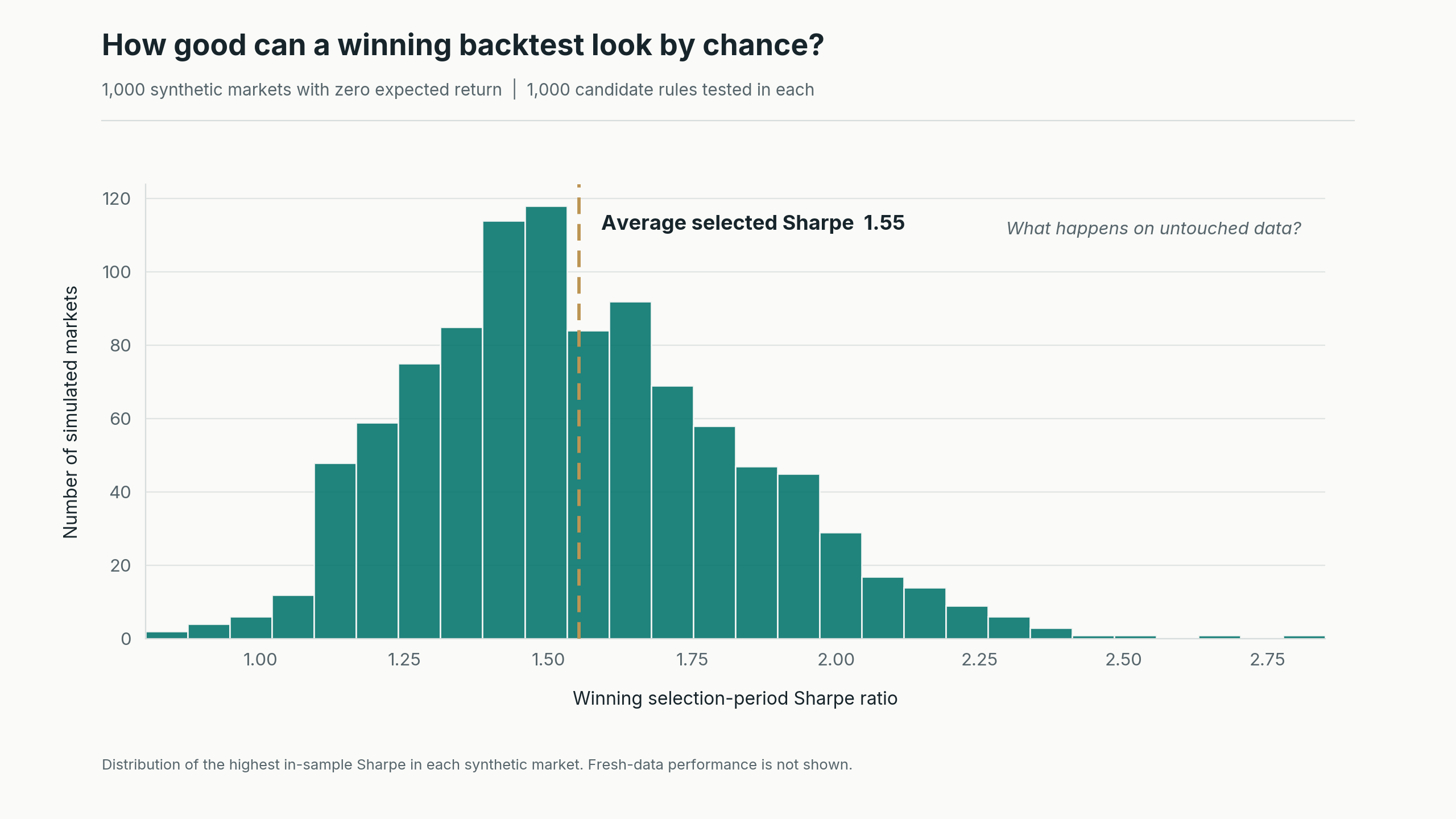
I tested 1,000 trading rules against simulated markets where no genuine predictive opportunity existed. Despite that, the winning strategies achieved an average backtest Sharpe ratio of 1.55 — a result that would normally attract serious attention.
What happened when those same strategies encountered fresh data was a very different story.
And that raises an even more interesting question: if the highest-performing strategy isn’t necessarily the best one, what should we actually be looking for?
In this article, I’ll look at what recent AI research is getting right, why seemingly excellent strategies can fail, and how to judge whether a new trading signal genuinely improves a portfolio once diversification and trading costs enter the picture.
Because finding a strategy that looks profitable is one thing. Finding one worth investing in is another.