

Gold is sending a message the rates model is failing to catch. The Fed is still restrictive, real yields are still high, and Treasury has just shown how sensitive Washington has become to the long end. Yet gold has pushed above $4,600. When an asset rallies through the condition meant to restrain it, the market is repricing the reason it owns it.
The Market Setup
The August tension is blunt: gold is rising in the part of the cycle where the textbook said it should struggle, and it is doing so as the U.S. debt problem becomes harder to hide.
On 18 August, Treasury data put U.S. public debt at $40.05 trillion. Two days later, Treasury’s long-bond buyback plan became the market’s live stress test: the cap for some longer-dated operations was doubled from $2 billion to at least $4 billion per operation, according to The Wall Street Journal, while officials framed the program as liquidity support. The market read was less polite. A government with a $40 trillion debt stock was trying to take pressure off long borrowing costs.
Gold noticed. On 20 August, Comex gold settled at $4,516.30 per ounce, according to Dow Jones market data. By early European trading on 21 August, gold futures hit $4,600, heading for a weekly gain of roughly 4%. The tension is that U.S. real yields remain high by post-2008 standards. The Federal Reserve’s H.15 release dated 20 August showed the 10-year inflation-indexed Treasury yield at 2.35% on 19 August and the 10-year nominal Treasury yield at 4.65%. Real rates are interest rates after inflation and they matter for gold. When inflation-protected bonds offer a high positive yield, gold needs a stronger reason to rise - and right now that reason is inflation persistence, debt pressure, and fading confidence in policy control.
The old model still matters. It is just leaving too much money flow unexplained.
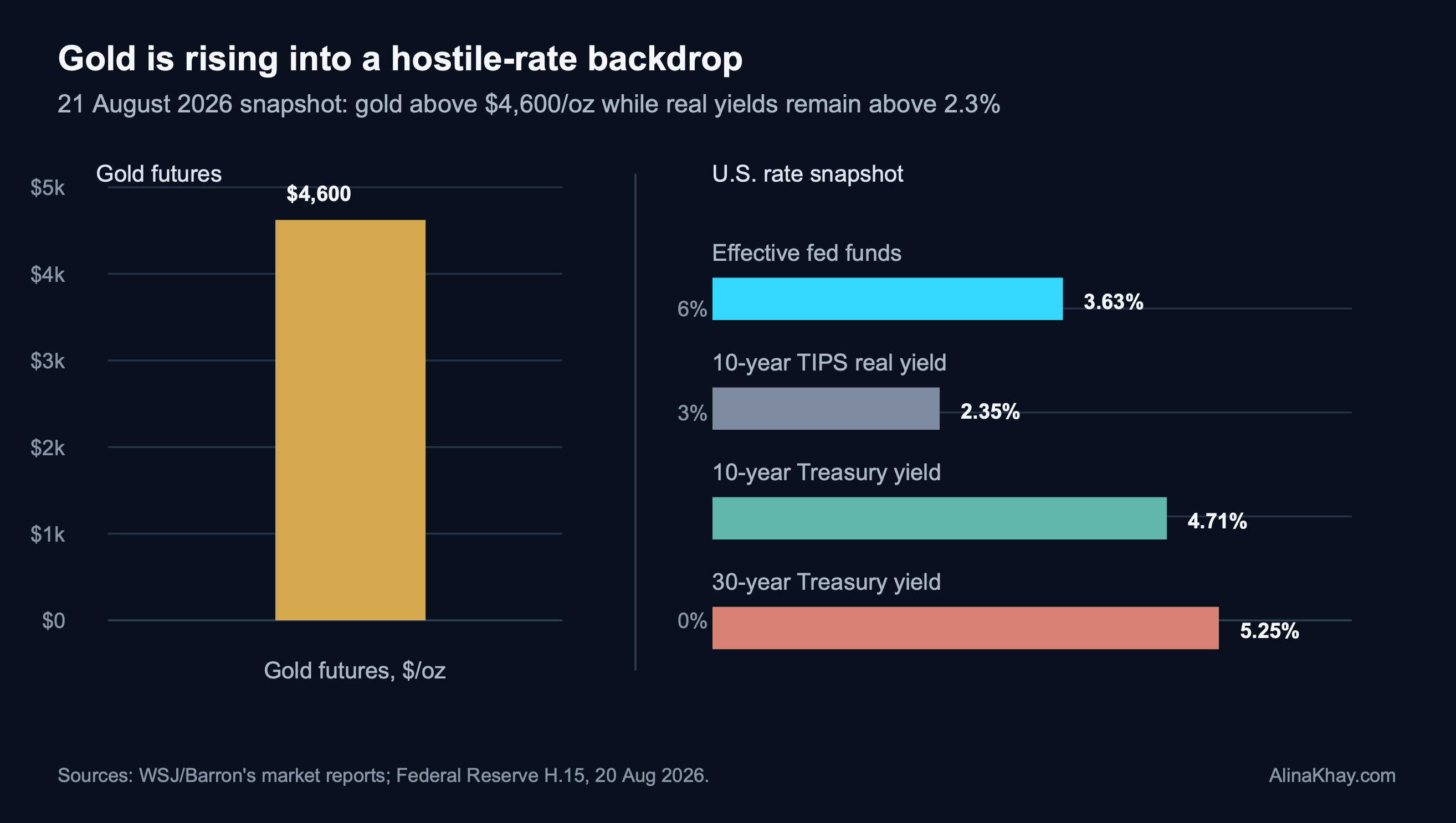
The Fed held the federal funds target range at 3.50% to 3.75% on 29 July. The minutes released on 19 August kept the inflation issue alive: many officials judged that additional firming could be needed if inflation failed to decline. July CPI, released by the Bureau of Labor Statistics on 12 August, cooled to 3.4% year on year, with core CPI at 2.5%, but the energy index was still up 14.7% from a year earlier.
For gold, those details matter. They define the setting in which the metal’s role changes. Treasury’s late-August buyback signal adds a new ingredient: the market is now watching the boundary between ordinary debt management and an official attempt to lean against long-end yields. That is where debt meets the gold price. When investors believe central banks and treasuries can control inflation, term premia, refinancing risk and currency risk at the same time, gold behaves like an expensive insurance policy. When investors doubt that control, gold starts to behave like a neutral reserve asset again.
A real-rate-driven rally is fragile. A debt-confidence rally can turn high-yield pullbacks or ETF weakness into accumulation windows.