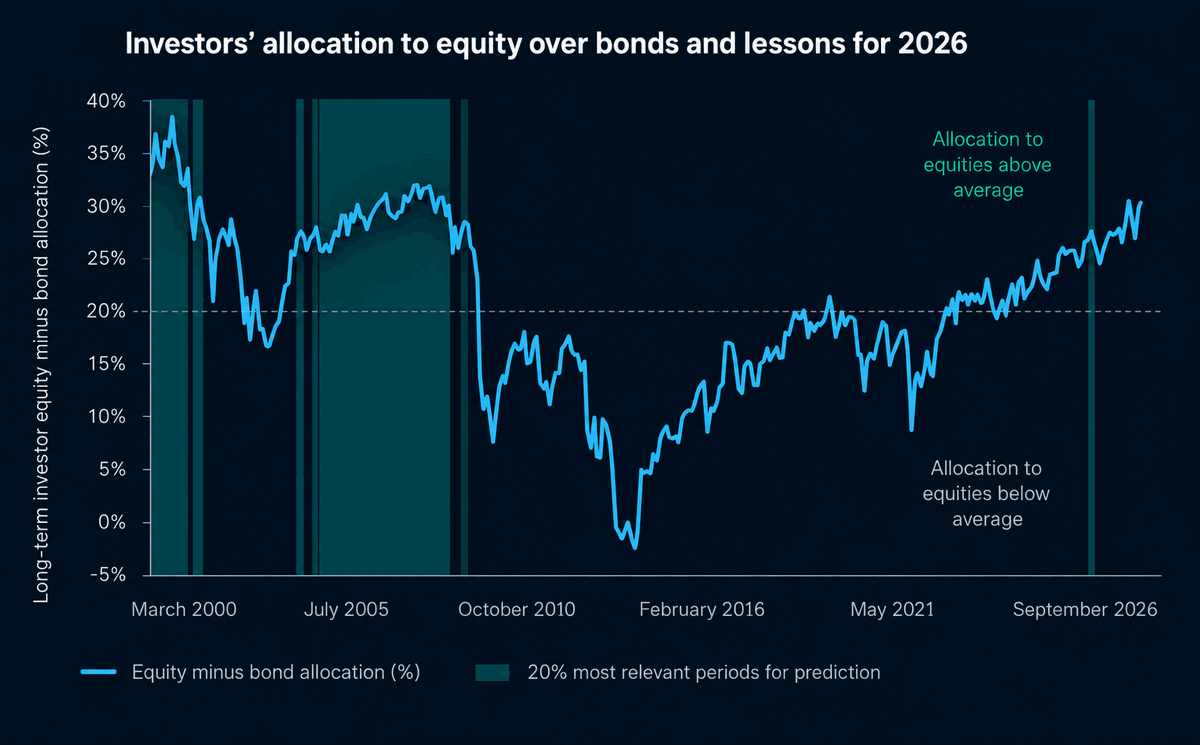
Twice this year my forecasting pipeline has produced a number I would rather not have published. The first time was January: custody-derived holdings data covering tens of trillions of dollars of institutional assets showed the largest investors in the world carrying their widest equity-over-bond allocation gap in 15 years, a configuration whose only historical parallels sit in 1999 to 2001 and 2004 to 2008. Six months and a 9 per cent rally later, that warning has been filed as a false alarm. Earnings grew at the fastest pace since 2021, the index printed records above 7,600, and positioning risk dropped out of the conversation.
The second time was two weeks ago, and it is why this piece exists, written to hand you a reusable test for any crowded trade rather than as a victory lap or a mea culpa. The midyear rerun shows the allocation gap widened past 30 percentage points, its most stretched reading since November 2007 - the month large banks began writing down the credit losses that became the financial crisis. At the same time, the rally presented as proof that markets have recovered is largely confined to the US. Even within the US, performance has been concentrated in a small group of high-earning companies, while most non-US equity markets fell over the same six months.
This article opens the process, showing how crowding, historical precedent, and exit conditions are translated into explicit probabilities, position sizing, and predefined conditions that would invalidate the thesis.
The consensus and I are looking at the same market. We disagree because we are asking different questions. The consensus is trying to forecast earnings. I am trying to forecast how prices behave when investors have already positioned for those earnings. Those are fundamentally different problems, and at the moment they lead to very different conclusions.
The output odds in uncertainty
A forecast without error bars is just a marketing claim. This is the method’s current output, expressed in its only honest form: as probabilities, recorded so it can be tested against reality. Roughly 55 to 60 per cent on bonds outperforming equities over the coming twelve months, 25 to 30 on the melt-up extending as earnings keep outrunning the discount rate, and the remainder on a muddle where neither side wins by much. Those are judgment-weighted probabilities. What follows from odds like these is not “sell everything”. It is a tilt: equity exposure trimmed back toward neutral against a strategic benchmark, the released risk parked where it is paid to wait, and convexity owned against both tails.
The process that produces those numbers has five stages. Here is each one, run live on July 2026.
Stage one: measure the crowding
Stage one asks a single question of the custody data: is the crowd’s position growing or shrinking relative to its own history? Institutional investors did not use the rally to trim their record equity overweight. They, in fact, added to it. The holdings data shows the equity-minus-bond allocation gap rising from just over 28 percentage points in January to more than 30 by midyear, against a 25-year average near 20. The March war shock briefly cut equity allocations by 1.6 points, the sharpest monthly de-risking since August 2023. April reversed it with a 2.1 point increase, one of the largest single-month jumps in a data history reaching back to 1998. June’s buying was funded by drawing down cash, with bond holdings untouched.