

The first quarter of 2026 is closing with a clear message: markets are on edge. After a strong 2025, the narrative has flipped. Stocks are sliding, with the S&P 500 posting its worst month since September 2022. Bond yields are spiking, with the 10-year Treasury above 4.45% and volatility in fixed income at an 11-month high. Brent crude is on track for its largest monthly surge since 1990, trading well above $100 a barrel, as the Iran conflict injects a war premium directly into the inflation pipeline. The Federal Reserve, which markets were confidently pricing to cut rates through 2026, is now being repriced toward a hike later on this year.

Geopolitical risk has flared exactly when investors are least prepared for it - and the reason they are least prepared is a liquidity problem that has been building quietly for years. Global investors entered this storm holding the least dry powder in a generation.
Today, I would like to break down the key signals flashing across charts and headlines right now across markets as we finished Q1 2026 and builds toward the question every investor is asking heading into the rest of the year: have we hit the bottom yet?
1. The Cash Is Gone: Global Investors Are “All In”
Perhaps the most alarming signal in Q1 2026 is not the oil price, nor the yield spike, nor the geopolitical flashpoint. It is a quieter number buried in J.P. Morgan’s flows data. Global non-bank investors’ cash holdings, measured as a percentage of total equities, bonds, and M2, have fallen to roughly 30%: near the lowest level this century. The post-2015 downtrend has continued without interruption, carrying cash well below both the pre-Lehman average and the post-Lehman average. Investors are, in the bluntest possible sense, all in.
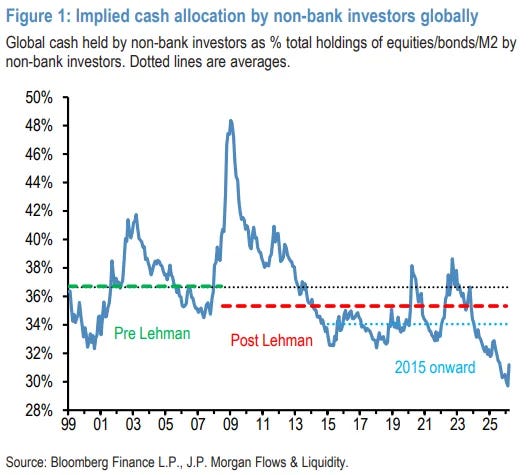
This matters not as a sentiment curiosity but as a structural liquidity problem. When dry powder is minimal, the shock-absorption capacity of the market collapses. A geopolitical escalation, a policy surprise, an earnings miss at a systemically important company - any of these, in a fully-invested market, does not encounter a wall of cash buyers waiting to deploy. It encounters margin calls. It encounters forced selling. It encounters redemption queues at funds that, like UBS last week, discover that the gap between their asset valuations and their liquidity commitments is wider than their models assumed.