

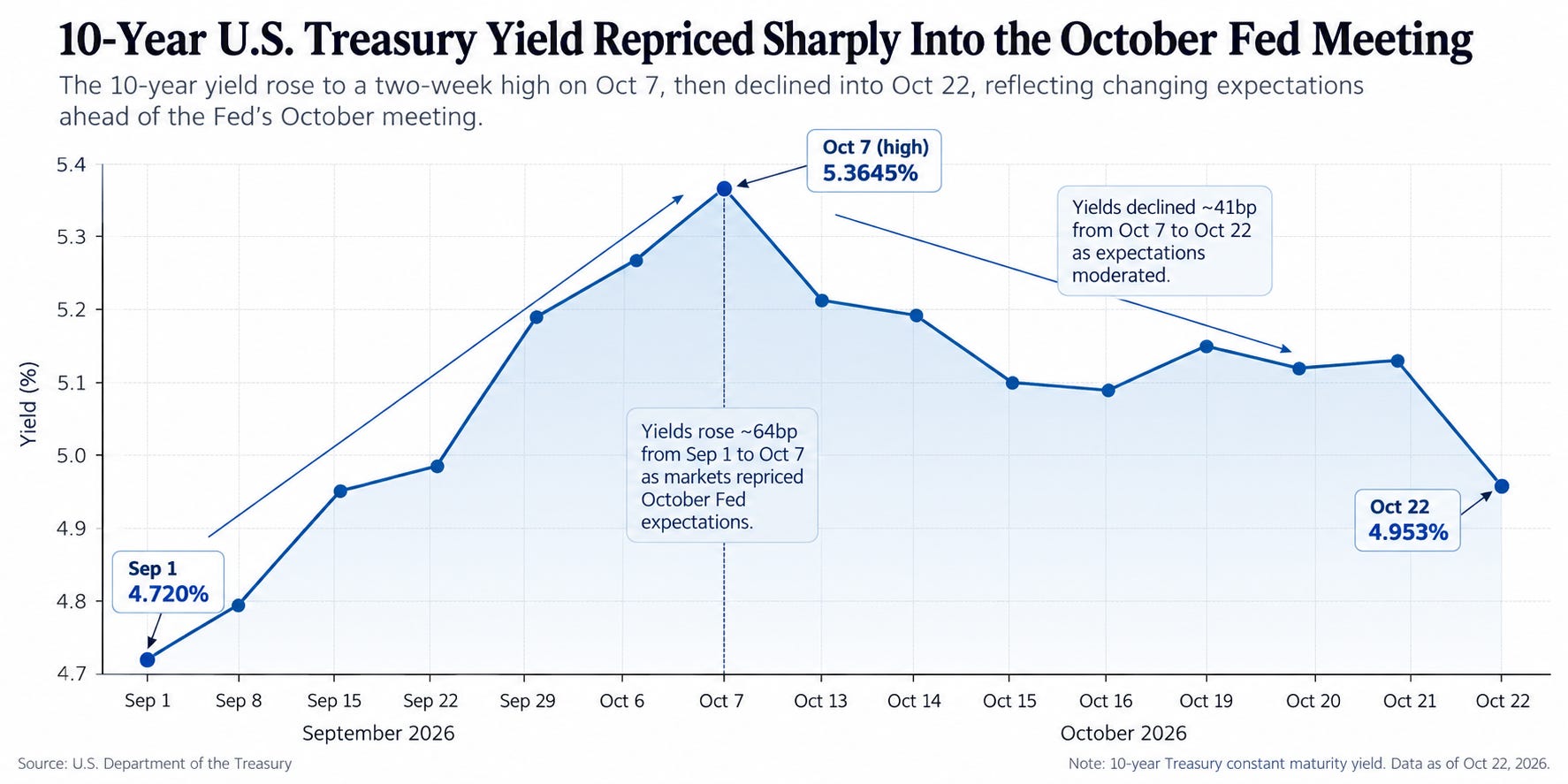
By the time the Federal Reserve announces its decision on Wednesday, 28 October, investors will already have spent weeks debating the likely outcome. A Reuters poll published on 20 October found that 94 of 100 economists expected the Fed to leave its policy rate unchanged at 3.75%-4.00%, with most expecting another increase in December.
If the Fed holds, the headline may tell markets very little. The more consequential information could be in the language around that decision: how officials describe inflation, how much weight they place on resilient demand, and whether they leave the door open to further tightening.
We have established ways to measure a rate surprise: compare the decision with what futures had priced. Measuring a narrative surprise is harder. A statement can repeat familiar words while shifting their emphasis; a press conference can make an apparently unchanged decision sound materially different.
The central idea of this article is to compare successive Federal Reserve communications and quantify both the change in tone and the change in meaning. The broader lesson reaches beyond the Fed: language is more useful when measured against what came before.