

For most of the post-2008 period, capital was easy to find and cheap to use. Companies could fund acquisitions, buybacks and expansion at low rates, while long-duration equities benefited from the steady decline in discount rates.
AI has arrived in a very different environment.
The largest technology companies are committing hundreds of billions of dollars to GPUs, data centres, networking, cooling and power. Governments are issuing heavily as well, while utilities and infrastructure developers need fresh capital for grids, generation and transmission. Several large pools of demand are now leaning on the same financing system at once.
The size of the AI opportunity is already well understood. What matters now is the return earned on the capital required to build it.
AI can still be one of the strongest growth themes of the decade. The hardeest part is turning that growth into free cash flow while financing costs, depreciation and power requirements are all moving higher.
AI Is Becoming an Industrial Build-Out
The public conversation still presents AI mainly as software: better models, new applications, automation and productivity. The spending profile looks increasingly industrial. Compute has to be bought, housed, cooled, connected and powered before a model can generate revenue at scale.
The scale is easier to appreciate when AI spending is placed alongside previous investment cycles. The five largest infrastructure spenders - Meta, Google, Microsoft, Oracle and Amazon - accounted for about 30% of combined S&P 500 and Nasdaq 100 capital expenditure in December 2025. Consensus estimates put that share at 48% by December 2028. By S&P Global’s estimates, eight years of AI-era capital spending could exceed the previous 26 years combined.
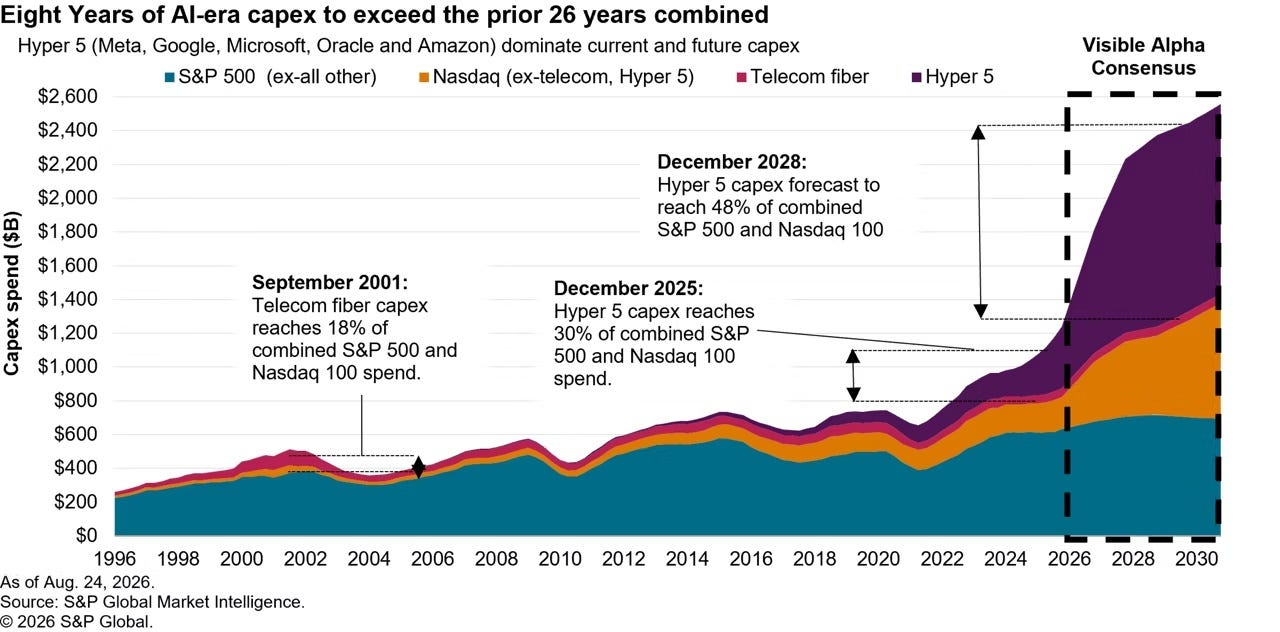
It does make capital efficiency increasingly important. When investment grows this quickly, even small differences in utilisation, financing costs, hardware lives and power availability compound into very different shareholder outcomes.