

Ski patrol never tries to predict the exact day an avalanche falls. They measure two things instead: the angle of the slope, which decides how far the snow travels once it goes, and the weak layer buried inside the snowpack, which decides whether it goes at all. Those are different questions with different answers, and confusing them is how people get buried.
Markets have the exact same two variables, yet almost nobody separates them. Valuation is a slope-angle measurement. It tells you, with useful precision, how far the market falls once something breaks. It tells you close to nothing about whether anything is about to break, and it never has.
This matters right now because the slope is close to the steepest ever recorded. The cyclically adjusted price-earnings ratio (CAPE), which compares today’s index level to the last decade of inflation-adjusted profits, hit 41.4 in July 2026 against a long-run average since 1881 of 17.8. Only December 1999 was higher. Twenty-four stocks now account for more than half the S&P 500’s value, a narrower base than the dot-com peak.
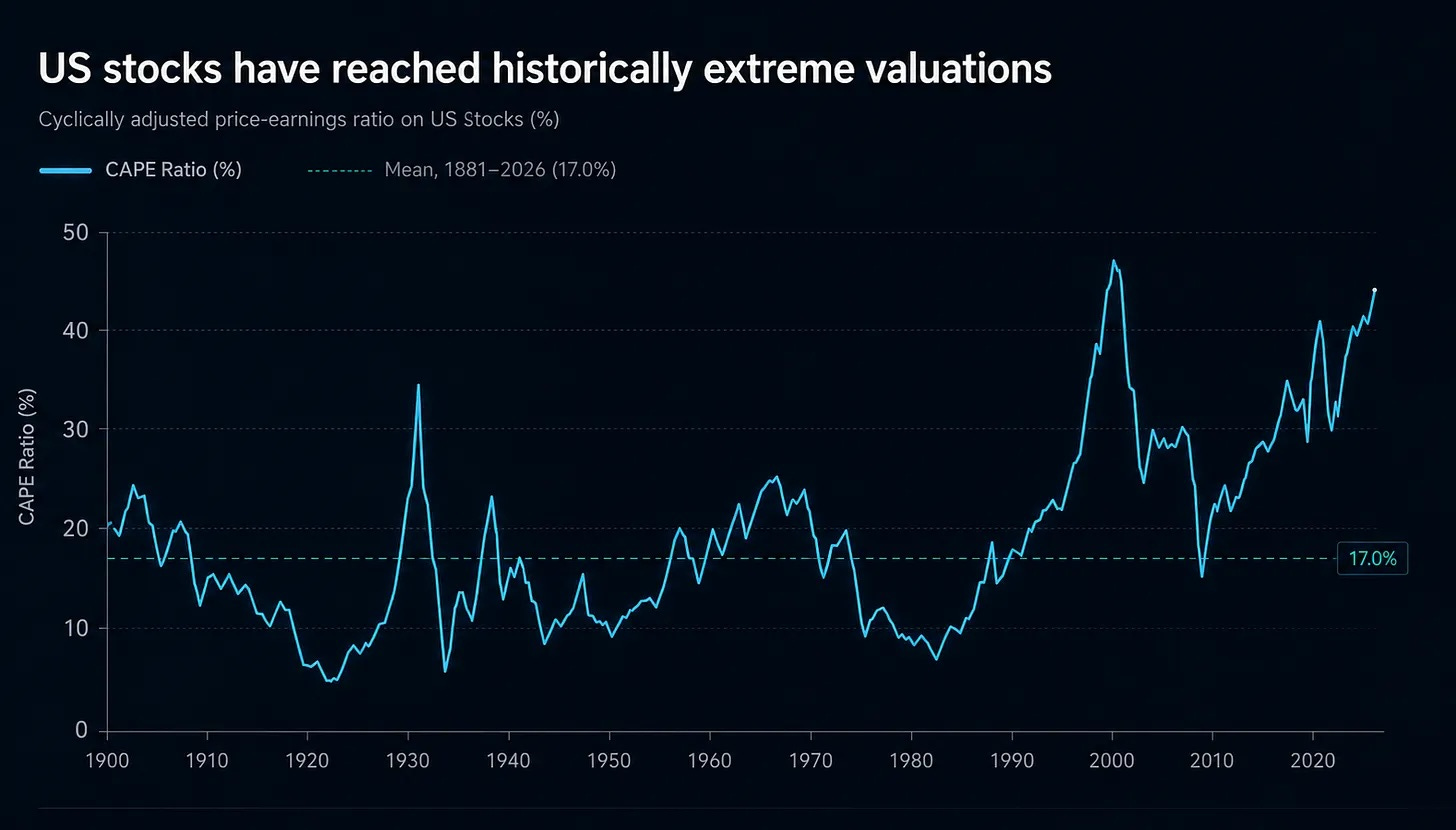
The same market that prices S&P 500 volatility at roughly 16, which is to say “we expect nothing much to happen,” is simultaneously pricing insurance against Nvidia defaulting at a record 82 basis points, and against Oracle at 215 after S&P Global cut it to the lowest investment-grade rung on 9 July. Two markets, looking at the same companies, in the same week, reaching opposite conclusions about how fragile they are.Let’s stop asking whether stocks are expensive; that question has been answered repeatedly while the index continued rising. The more useful question is what releases a market priced this way, and how deep the run-out zone becomes when it does.